

An RMR-cut slide for a Glock 17 or Glock 19 will accept dozens of different optics, and the price spread between the cheapest and the most expensive runs past ten to one. That range is the actual problem: nothing on the shelf is obviously wrong, and the things that separate an entry-tier dot from a duty-grade one — housing rigidity, dot crispness under recoil, how the electronics survive slide cycling — do not show up on a spec sheet. This guide sorts the RMR-footprint optics in stock at 3CR Tactical into three budget tiers and says what you give up as you move down.
Shopping for a slide? Browse our Glock 19 slides and Glock 17 slides, stripped or shop-assembled.
Why the RMR Footprint Dominates Glock 17 and Glock 19 Slides
A slide for Glock 17 or Glock 19 has the width and length for the full-size RMR housing, so cutters standardized on that pattern and the aftermarket followed. Our in-house assembled slides for these two are predominantly RMR-cut for the same reason: it is the cut with the widest optic selection behind it. Footprint is also the one spec you cannot work around later — an optic either bolts to your cut or it does not.
If you are still identifying your pattern, the pistol red dot footprint explainer maps every major one, and the RMR vs RMSc vs Holosun K comparison covers how those three differ on Glock slides. For every optic that shares the RMR pattern, see the RMR footprint list. Undecided on whether you want a cut at all? Start with RMR cut vs iron sight slide. And note this is not the slimline conversation — the Glock 43X and Glock 48 use the narrower RMSc pattern, and that list lives in the RMSc picks article.
Entry Tier: Getting Onto a Dot Without Overspending
This bracket buys a working red dot on an RMR-cut slide: adequate glass, honest battery life, housings that handle range use and occasional carry. These are not duty optics and we will not present them as such.
The NcStar VISM Flipdot M2 is the odd one out and the cheapest way onto a dot. The lens folds flat into the body and flips up to power on, with backup iron sights built into the unit. It projects a 3 MOA dot with 1/2 MOA clicks and ships with a Glock MOS plate plus a 2mm RMR spacer, covering both RMR-cut and Glock MOS slides.
The UTG OP3 Micro and the UTG OP3 Micro SLS are the same 4 MOA optic with one difference worth understanding. The base OP3 Micro uses a magnetized battery compartment and claims roughly 55,000 hours of runtime. The SLS costs a little more, claims roughly 15,000 hours, and loads the battery without unmounting the optic. You are paying more for shorter claimed runtime in exchange for not pulling the optic off the slide to change a cell. Shoot often and a battery you can reach without unmounting earns its keep; if the gun mostly sits in a safe, take the battery life.
The Meprolight MPO-DF runs a 3.5 MOA dot on the RMR footprint and is the most conventional pick in this tier. Our own product page says it plainly and we will repeat it: this is not a Trijicon-tier duty optic. For range work and light carry it is fine.
The OSight C in red and the OSight C in green are the most feature-dense option at this level: open-emitter sights on the RMR footprint with a switchable reticle — a 3 MOA dot, a 32 MOA circle, or both. Circle-dot reticles genuinely help new red dot shooters find the window faster under stress, and getting that this far down the price ladder is unusual. Stock on both runs thin.
Mid Tier: Where the Value Actually Lives
This is the bracket most buyers should be shopping. Housings get stiffer, coatings get better, and the feature sets start looking like the benchmark optics.
The Swampfox Liberty II in red and the Liberty II in green are the compact option, a 1x24mm window with a 3 MOA dot on the RMR footprint. The smaller window keeps the optic low and unobtrusive on a slide for Glock 19, and the 3 MOA dot is precise enough for distance work. This is the mid-tier carry pick.
The Swampfox Justice II goes the other direction: an oversized 30mm round window with a 6 MOA green dot, built around competition use. Bigger window, faster pickup, more optic on top of the slide. A 7075-T6 housing, ten brightness settings, Shake 'N Wake power management and a top-loading battery tray. If your Glock 17 is a match gun, look here first.
The Meprolight MPO Pro-F brings the circle-dot reticle into the Pro line on the RMR footprint — fast outer-circle pickup, fine center dot for refinement, better glass than the MPO-DF below it. If you liked the OSight C reticle concept but want a step up in optical quality, this is the upgrade path.
The Viridian RFX44 Compact and the Viridian RFX45 Closed are two of the enclosed-emitter options here, both projecting a 5 MOA green dot. Read the fitment carefully, because it is not what most buyers assume: both are natively cut for the Aimpoint ACRO footprint and ship with an RMR-footprint adapter. They work on your RMR cut by way of that included adapter, not by direct mounting. The RFX45 adds a 24x15.5mm multi-coated window, ten brightness settings including two night-vision levels, 90 MOA of adjustment travel and a CR2032 cell.
Benchmark Tier: The Trijicon RMR Type 2
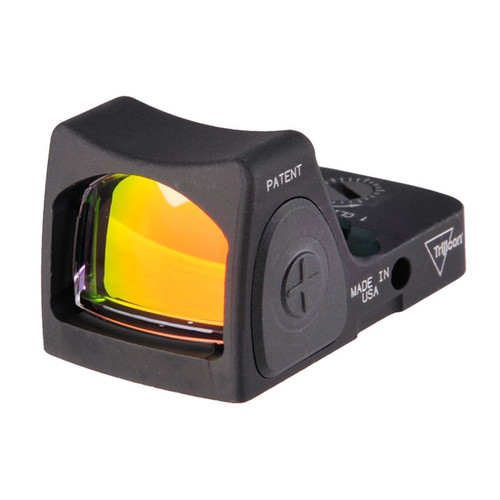
The RMR is the optic the footprint is named after and still the reference point for duty use: a 7075-T6 forged aluminum housing, IPX7 waterproofing to 65 feet, eight brightness settings, two of them night-vision compatible, 1 MOA adjustments, 1.2 oz, and a CR2032 cell rated around four years at a moderate setting. The battery loads from the bottom, which means taking the optic off the slide to change it.
Four variants are in stock. The RM06 with a 3.25 MOA red dot in black is the standard duty and carry configuration and the one most people should buy. The RM06 in 3.25 MOA green is the same optic with a green emitter, and it currently carries our deepest stock in the whole category. The RM06 in FDE is that same red 3.25 MOA configuration in a flat dark earth housing. The RM07 with a 6.5 MOA red dot is the large-reticle variant favored by competition shooters and anyone who values speed of acquisition over fine precision at distance.
At the time of writing the RM06 in black sits at $604.99 — roughly five times the entry tier. The honest framing: you are buying durability and long-term dot consistency, not a dramatically better sight picture on day one.
Green or Red: Where It Is a Real Choice
Several optics here come both ways. The RM06, the Liberty II and the OSight C all have red and green versions, while the Viridian pair is green only, and the Justice II we stock is the green version. That makes emitter color a decision rather than a default.
Green sits nearer the peak of human daylight sensitivity, so many shooters report picking a green dot up faster against dark targets, shaded ranges and foliage. Red is the traditional choice and some shooters with astigmatism find one color noticeably cleaner than the other. There is no universally correct answer, and the difference is smaller than marketing suggests — if you can look through both before buying, do that. Dot size is the other half of the decision and deserves more room than a paragraph; we covered it in the MOA dot size guide, worth reading before you lock in 3 MOA versus 6 MOA.
Open or Enclosed Emitter on a Full-Size Glock
Most optics above are open-emitter designs, with the LED sitting exposed in a channel and projecting forward onto the lens. Enclosed-emitter optics seal that path so rain, lint and debris cannot block the dot at the worst possible moment, at the cost of height, weight and money. On a slide for Glock 17 or Glock 19 that size penalty is far less painful than on a subcompact, which is why enclosed designs make more sense here than on a slimline. Both Viridian options are enclosed. The full argument is in open vs enclosed emitter red dots.
What About the DeltaPoint Pro?
The Leupold DeltaPoint Pro comes up in every full-size Glock optic conversation, so it needs an explicit answer: it is not an RMR-footprint optic. It uses its own mounting pattern and will not drop onto an RMR-cut slide. It is an excellent sight — a wider front-to-back lens than the RMR, an aspherical lens that holds distortion down, motion-activated auto-on, Leupold's lifetime guarantee — but only if your slide is cut for it or you are running the correct plate.
If your slide is DeltaPoint-cut, we stock the DeltaPoint Pro with a 2.5 MOA dot in black, the 6 MOA version, and a night-vision-compatible 2.5 MOA model in FDE. If your slide is RMR-cut, buy from the tiers above instead.
The Slide Underneath the Optic
An optic list is only useful if the slide beneath it has the right cut. Our assembled slides for Glock 17 and Glock 19 are shop-assembled in-house and predominantly RMR-cut, which is why this list takes the shape it does. Browse the assembled Glock slides selection for a slide that arrives ready to take an optic, or the broader Glock slides category if you are sourcing a stripped slide. Check the optic cut before you order — that is the spec that has to match, and individual slide availability moves week to week.
Once an optic is mounted, factory-height iron sights will most likely sit below the optic window rather than through it. Suppressor-height sights solve that, and the geometry of absolute versus lower one-third co-witness is covered in the co-witness setups guide.
Before You Order
Three fitment checks, in the order they trip people up. Confirm your slide is cut for the RMR footprint specifically, not just described as optic-ready — that phrase covers several different patterns. If you are running a Glock MOS slide rather than a directly milled RMR cut, you need the correct adapter plate in between; of the optics above, only the NcStar Flipdot M2 ships with a Glock MOS plate in the box. And if you are looking at the Viridian RFX44 or RFX45, remember the RMR mounting comes from the included adapter, not the optic's native footprint. Mounting hardware varies by optic and by whether a plate is in the stack, so confirm what your specific combination needs before ordering.
The Short Version
Still finding out whether you shoot better with a dot? Start in the entry tier and accept its limits. For a gun you carry or compete with, the mid tier holds the value — Liberty II for carry, Justice II for competition — and for a duty gun, buy the RMR Type 2 and stop thinking about it. Whichever tier you land in the cut has to match the optic, so confirm the footprint on the assembled Glock slides category page before you add an optic to the cart.
DISCLAIMER: "GLOCK" is a federally registered trademark of GLOCK, Inc. and is one of many trademarks owned by GLOCK, Inc. and GLOCK Ges.m.b.H. Neither 3CR Tactical nor this site are affiliated in any manner with, or otherwise endorsed by, GLOCK, Inc. or GLOCK Ges.m.b.H. The use of "GLOCK" on this page is merely to advertise the sale of GLOCK pistols, parts, or components. For additional genuine GLOCK, Inc. and GLOCK Ges.m.b.H products and parts visit www.glock.com.