
Slide cut and optic footprint are not the same thing — and getting them mixed up is the single biggest mistake we see at checkout. A footprint is the mounting pattern on the bottom of an optic. A slide cut is the milled recess on top of the slide that has to match it. If the screw holes and recoil lugs don't line up, the optic doesn't sit flat, and nothing you torque it to will make it shoot zero. This guide maps every major pistol red dot footprint in the 3CR Tactical catalog to the optics, slides, and adapter plates that go with it.
What a Footprint Actually Is
A footprint is a standardized hole pattern and recoil-lug arrangement on the underside of a reflex sight. Optic manufacturers settle on a pattern, slide makers cut to match, and from then on every optic and every slide that share that pattern interchange — or should. The footprints below cover roughly 95% of what gets sold on Glock-pattern, Sig, and Smith & Wesson slides today. To look up a specific optic, the optic footprint compatibility chart lists every model with its footprint and what it interchanges with.
Two things make up a footprint:
- Screw pattern — center-to-center spacing of the mounting screws, plus thread size (typically 6-32 or M4)
- Recoil lugs — small posts or pins on the underside of the optic that key into matching cuts in the slide; these absorb slide cycle force so the screws aren't doing it alone
Two optics with the same screw pattern but different recoil lugs are not interchangeable. The optic might sit flush on a slide that doesn't have the matching lug cuts, but it will batter its own screws loose under recoil. Always verify both before mounting.
Why the Footprint Decision Comes First
The optic you choose dictates the slide you can buy, or vice versa. If you already own a slide with a specific cut, your optic options narrow to that one footprint plus anything you can adapt to it with a plate. If you're starting from a stock MOS pistol — Glock MOS, Glock Gen 5 / Gen 6 MOS, Sig P320 — you're locked into the manufacturer's plate system unless you mill the slide.
The order we recommend: pick the footprint first based on your use case (carry, duty, comp, range), then pick the optic in that footprint, then pick the slide cut to match. Buying the slide first locks you into whatever optic family that slide supports, and that's how shooters end up returning optics or selling slides on classifieds.
RMR Footprint (Trijicon)
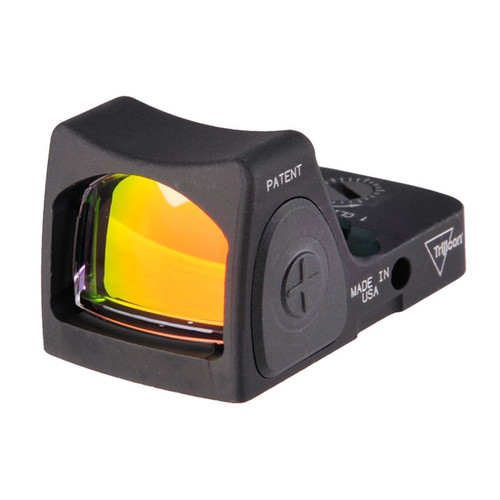
The RMR footprint is the most common cut on the market. It uses two screws on a roughly 0.92" centerline with two recoil-lug posts forward of the screws. Every Trijicon RMR Type 2 — including the RMR Type 2 RM06 with 3.25 MOA dot — uses this pattern. The Trijicon RMR HD and SRO share the same footprint, so an RMR-cut slide accepts any of the three families.
Holosun followed suit with their 407c, 507c, and 508T series, which is why "RMR-cut" is shorthand for any of them. The Meprolight MPO line includes RMR-pattern variants (MPO-DF, MPO-F, MPO Pro-F) at lower price points, and several less-common optics — including some Vortex and Swampfox models — adopted the same pattern over the past decade.
What's cut for RMR in our catalog:
- Most full-size and compact slides for Glock 17, 19, 22, 23, and 26 in our assembled and stripped lineups
- Glock MOS slides with the matching plate (Glock plate #1 on Gen 4 MOS, or a Calculated Kinetics adapter on Gen 5 / Gen 6 MOS)
- Meprolight MPO-DF, MPO-F, and MPO Pro-F — all RMR-pattern alternatives at a lower price point
- Nordic Components optic plates with integrated backup or night sights, RMR variant
RMR is the safe default. If you're shopping a Glock 17, 19, 22, 23, or 26 slide and you don't have a strong reason to pick something else, RMR has the deepest optic selection and the widest used-market resale.
RMSc Footprint (Shield) — and Why "K Footprint" Means the Same Thing
RMSc was Shield Sights' subcompact pattern. It uses a narrower screw centerline (~0.658") and a different recoil-lug geometry than RMR. The whole point was to fit on narrow slides like the Glock 43, 43X, and 48 where there isn't room for an RMR. Holosun adopted the same pattern and calls it the "K footprint" — Holosun 407K and 507K mount on any RMSc-cut slide and vice versa. J-Point is also compatible. So when a slide listing says "RMSc / J-Point / Holosun K," it's all one footprint.
This naming overlap causes more confusion than any other footprint in the catalog. The short version: if a product page lists any of "RMSc," "K-footprint," or "J-Point," they all bolt to the same slide cut and the same screw pattern.
What's cut for RMSc in our catalog:
- Stripped Window Slide for Glock 43/43X in black nitride
- Assembled Window Slide for Glock 43/43X — barrel and sights installed
- Meprolight MPO-S Circle Dot — RMSc / J-Point
- Meprolight MPO Pro-S — same pattern, premium glass
The Trijicon RMRcc deserves a callout: it's similar in size and intent to RMSc but uses a slightly different screw and lug pattern. The RMRcc fits subcompact slides cut specifically for the RMRcc footprint. It is not directly interchangeable with RMSc, despite serving the same subcompact-carry role.
If you own a Glock 43X or 48 MOS, the factory cut is RMSc — narrower than the full-size MOS plate system. You cannot bolt an RMR-pattern optic onto a 43X MOS without a non-stock adapter, and adapter plates that span those two footprints are uncommon because the slide width simply doesn't support the wider RMR housing.
Aimpoint ACRO P2
The ACRO footprint is unique to Aimpoint. It uses four screws in a square pattern and a substantial recoil lug — designed to handle pistol slide velocity with a closed emitter housing. ACRO-cut slides are less common from the factory; most ACRO mounting on Glocks happens through a plate.
What ACRO buys you: enclosed emitter durability (no lint, sweat, or weather killing the dot), proven duty-grade build, and a small enough form factor for carry on full-size slides. What it costs: weight and stack height. An ACRO sits taller than an RMR, which is why suppressor-height sights are practically mandatory for any kind of co-witness on an ACRO setup.
What we sell for ACRO:
- Calculated Kinetics MOS-to-ACRO P2 plate for Gen 4 MOS slides
- Calculated Kinetics Gen 5/Gen 6 MOS-to-ACRO P2 plate
- Nordic Components Optic Plate + Backup Sights for ACRO — adds suppressor-height irons in the same package
- Bushnell FastFire E — ACRO-pattern enclosed emitter at a more accessible price
Delta Point Pro Footprint (Leupold)
The Leupold DeltaPoint Pro has its own footprint — two screws on a wider centerline than RMR, with a forward-canted housing that gives it a distinct profile. DPP cuts are common on competition slides and on Smith & Wesson M&P optic-ready models. The Leupold DeltaPoint Pro 2.5 MOA mounts to any DPP-cut slide or to a matching adapter plate.
Where DPP shows up most often:
- Smith & Wesson M&P 2.0 Optic-Ready uses DPP as one of the included plate cuts
- Springfield and Walther optic-ready models include DPP plates
- Glock MOS pistols can mount DPP with a manufacturer plate; aftermarket DPP plates exist but are less common than RMR or ACRO
- Custom competition Glock slides often cut DPP because the lower-profile housing tracks well between targets
Holosun EPS / EPS Carry — Enclosed K-Style
The Holosun EPS is an enclosed emitter optic with its own footprint that overlaps the K-style screw pattern. The EPS Carry is the subcompact version. Both can mount to RMSc-cut slides with the right adapter or to MOS slides through a plate. The EPS is one of the most popular enclosed-emitter optics on the market right now because it hits a price point well below the ACRO while delivering the same lint-and-weather immunity.
What we sell for EPS:
- Calculated Kinetics MOS-to-K/RMSc plate — adapts Gen 4 MOS to EPS Carry and other K-footprint optics
- Calculated Kinetics Gen 5/Gen 6 MOS-to-Holosun EPS plate
- Nordic Components Optic Plate + Backup Sights for Holosun EPS
- Nordic Components Optic Plate + Night Sights for Holosun EPS
Holosun 509T Footprint
The 509T uses a proprietary footprint with its own screw and lug pattern — closed emitter, titanium housing, built for duty use. 509T-cut slides are rare; most 509T mounting happens through an adapter plate. The titanium housing makes the 509T heavier than the EPS but more impact-resistant, which is why it tends to land on duty rigs rather than concealed carry setups.
- Calculated Kinetics Gen 5/Gen 6 MOS-to-509T plate
- Nordic Components Optic Plate + Night Sights for Holosun 509T
- Nordic Components Optic Plate + Backup Sights for Holosun 509T
Sig Romeo-RS Pro and Compact
Sig Sauer made two Romeo-RS variants with deliberately separate footprints. The Compact footprint is for narrower slides (and is the cut used on the P365 X-Macro and similar). The Pro footprint is wider, with a different screw and lug pattern for full-size optic-ready slides.
- Sig Romeo-RS 3 MOA Compact Footprint — for slides cut to the compact pattern
- Sig Romeo-RS Pro 3 MOA — for full-size Pro-pattern slides
Pro and Compact are not interchangeable. Verify which one your slide is cut for before ordering — a P320 Pro slide takes the Pro footprint; a P365 X-Macro takes the Compact. Sig prints the footprint on the spec sheet of every optic-ready pistol they sell.
Glock MOS — Why "MOS" Isn't a Footprint
Glock MOS (Modular Optic System) is a plate-based mounting system, not a footprint of its own. Every MOS slide ships with a plate slot and a set of adapter plates that convert that slot to a specific optic footprint. Gen 4 MOS, Gen 5 MOS, and Gen 6 MOS all use different plate dimensions, which is why an adapter plate that fits a Gen 4 MOS does not fit a Gen 5 MOS — even if both are adapting to the same target optic.
If you have an MOS pistol, your decision flow is:
- Identify the MOS generation (Gen 4 / Gen 5 / Gen 6)
- Pick the target footprint (RMR, RMSc, ACRO, EPS, 509T, DPP)
- Buy the matching Calculated Kinetics or Nordic Components plate
- Buy the optic in that footprint
The plate adds 4–8mm of stack height, which is the main reason MOS optic setups often need suppressor-height irons for co-witness — covered in detail in article 5 of this series.
What to Do When Your Slide Isn't Cut for the Optic You Want
The honest answer most retailers skip: you have three options.
Option 1 — Buy an Adapter Plate
Adapter plates bridge a slide cut (or an MOS plate slot) to a different optic footprint. This is the cleanest path on Glock MOS slides because the factory plate slot is designed for it. Plates add a few millimeters of stack height, which factors into your sight setup (covered in the co-witness article in this series). Browse the Calculated Kinetics and Shield Sights categories for slide mounts and MOS plates that cover most common footprint conversions.
Option 2 — Buy a Different Slide
If you don't already own the slide, just buy one cut for the optic you actually want. Browse the Glock pistol optics selection alongside the Glock slides category and match the footprint at the point of purchase. This is cheaper and more reliable than stacking a plate on a non-matching slide.
Option 3 — Have a Slide Milled
A gunsmith can re-cut an existing slide to a different footprint — but this is rarely cost-effective versus selling the slide and buying one cut correctly. We don't recommend it unless the slide has sentimental or competition-rules value.
Footprint Quick-Reference Table
| Footprint | Representative Optics | Typical Slide Application |
|---|---|---|
| RMR | Trijicon RMR Type 2, RMR HD, SRO; Holosun 407c / 507c / 508T; Meprolight MPO RMR-pattern | Glock 17/19/22/23/26 full-size and compact slides, MOS with plate |
| RMSc / K / J-Point | Meprolight MPO-S, Holosun 407K / 507K, Shield RMSc | Glock 43/43X/48, subcompact slides |
| RMRcc | Trijicon RMRcc | Subcompact slides cut specifically for RMRcc (not interchangeable with RMSc) |
| Aimpoint ACRO | Aimpoint ACRO P2, Bushnell FastFire E | Adapter plate on MOS slides; ACRO-native cuts are uncommon |
| Delta Point Pro | Leupold DeltaPoint Pro | M&P 2.0 Optic-Ready, competition slides, MOS with plate |
| Holosun EPS / EPS Carry | Holosun EPS, EPS Carry | Adapter plate on MOS slides, K-cut subcompact slides |
| Holosun 509T | Holosun 509T | Adapter plate on MOS slides; 509T-native cuts are rare |
| Sig Romeo-RS Compact | Romeo-RS Compact | Sig P365 X-Macro and similar compact-cut slides |
| Sig Romeo-RS Pro | Romeo-RS Pro | Full-size Pro-pattern optic-ready slides |
Common Mistakes to Avoid
Three things we see at the support desk every week:
- Buying an optic before checking the slide cut. Always verify the slide is cut for the optic, or that an adapter plate exists, before the optic ships.
- Assuming RMSc and Holosun K are different. They're the same footprint. Same screw spacing, same lug geometry. Different brand names.
- Mixing MOS generations. A Gen 4 MOS plate doesn't fit a Gen 5 MOS slide. Verify the generation on the slide before ordering the plate.
Where to Go From Here
If you already know your footprint, browse the pistol optics category filtered by Compatibility and pick the optic that fits. If you have an MOS pistol and want a different footprint than the factory plates support, the Calculated Kinetics plate series and Shield Sights mounts cover almost every common conversion. The rest of this series breaks down how to choose dot size, when to go enclosed-emitter, and how to handle co-witness once the optic is on the slide.