
Open vs enclosed emitter is one of the few red dot decisions where the failure modes are physical and obvious. Lint clogs an open emitter. Sweat fogs the front lens. Rain pools across the LED housing. Snow blocks the dot until the pistol warms up. None of those are theoretical — they happen to carry guns sitting in waistbands and pockets all day. Enclosed emitter optics solve the problem at a cost in weight, stack height, and dollars. This guide picks between them based on how you actually carry, not based on which one looks more "duty grade" in a catalog photo.
The Difference, in One Paragraph
An open-emitter red dot has the LED mounted on the rear post of the housing, projecting forward through open air onto the front lens. The light path is exposed. An enclosed-emitter optic seals that light path inside a closed housing — typically with a rear lens behind the LED — so the only thing the outside world can touch is the front and rear glass. Open emitters are lighter and lower-profile. Enclosed emitters are sealed against lint, sweat, and weather.
Where Open Emitters Fail
Three common failure modes on carry pistols:
Lint and Debris
The most consistent killer. Pocket carry, deep-concealment IWB with a t-shirt over the optic, range bag transport — every one of them deposits lint and pocket grit on the emitter and the inside of the front lens. A single piece of lint on the LED partially obscures the dot. Enough buildup, and the dot dims or disappears entirely. The fix is canned air and a cleaning swab — fine at home, useless if you draw the pistol and the dot isn't there.
Sweat and Humidity
Sweat-soaked appendix carry in summer drips down the slide and pools on the optic. Open emitters trap that moisture between the LED and the front lens, where it condenses on cooling and fogs the light path. Enclosed emitters seal the entire light path; only the exterior of the front lens fogs, and that wipes off in one swipe.
Rain and Snow
Outdoor duty and outdoor range time put open emitters in front of rain droplets that pool on the LED, refract the dot into a smear, or block it entirely. Snow piles up on the inside of the housing and melts when the pistol warms up — which is exactly when you don't want a wet emitter. None of this affects an enclosed optic the same way.
Where Open Emitters Win
Open emitters aren't obsolete. They win on three things:
Weight and Stack Height
An open-emitter RMR weighs about 1.2 oz. An Aimpoint ACRO P2 weighs about 2.1 oz. On a carry pistol you can feel that 0.9 oz difference, and the lower-profile open housing prints less under clothing. Stack height matters even more — an enclosed optic adds a few millimeters above the slide, which pushes co-witness math into suppressor-height sight territory.
Price
An open-emitter Trijicon RMR Type 2 RM06 runs roughly $500. An Aimpoint ACRO P2 runs roughly $600. A Holosun EPS Carry runs roughly $400. The price gap has narrowed over the past three years, but enclosed emitters still generally cost more per tier — and the entry-level enclosed optics are a noticeable step down in glass quality from entry-level open ones.
Field of View
Open-emitter housings can be made thinner, which usually translates to a wider, less obstructed window. Enclosed optics need to seal the entire light path, which adds housing material around the lens. Most shooters don't notice the difference once they're trained on the optic, but it shows up most in fast transitional shooting between targets.
Picks by Carry Profile
Deep Concealment IWB / Pocket Carry — Go Enclosed
If the pistol lives against your skin under a shirt, or rides in a pocket, you need an enclosed emitter. Lint accumulation on an open emitter under these conditions is not a maybe — it's a daily occurrence. Two picks:
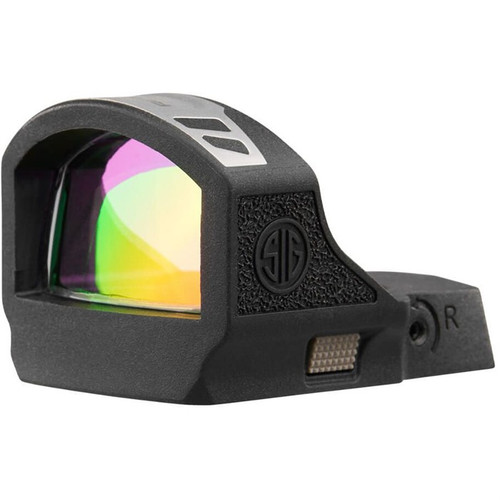
- Sig Romeo-RS Pro 3 MOA — enclosed emitter at a competitive price, Pro footprint for full-size optic-ready slides
- Sig Romeo-RS 3 MOA Compact — same optic, compact footprint for narrower slides like the P365 X-Macro
- Bushnell FastFire E with ACRO attachment — ACRO-pattern enclosed emitter under $300, ships with an ACRO adapter
OWB Duty Carry — Enclosed, Built for Abuse
Duty rigs are exposed to weather, vehicle entry/exit, and ground contact during fights. Enclosed is the answer, and the housing material matters more than the price gap.
- Aimpoint ACRO P2 — the duty default; titanium-reinforced housing, 50,000-hour battery on the cell
- Holosun 509T — titanium housing, multi-reticle, sits on a lot of agency-approved lists
- Trijicon RMR HD — note: this is still an open emitter despite the housing redesign; included here because shooters often confuse it with the closed RMR HD concept
If you're running ACRO or 509T on a Glock MOS pistol, you need the right adapter plate:
- Calculated Kinetics MOS-to-ACRO P2 plate for Gen 4 MOS
- Calculated Kinetics Gen 5/Gen 6 MOS-to-ACRO P2 plate
- Calculated Kinetics Gen 5/Gen 6 MOS-to-509T plate
Competition / Range — Open Emitter Is Fine
Match guns and dedicated range pistols sit in cases between uses and run in controlled conditions. Open emitters are the obvious answer here — lighter, faster, cheaper, and the failure modes that kill them in carry contexts don't exist on a match gun. The Trijicon RMR Type 2 RM07 6.5 MOA is the proven choice for USPSA, IDPA, and steel challenge speed work.
Hybrid Use (Some Carry, Some Range) — Enclosed With a Smaller Dot
If one pistol has to do both jobs, default to enclosed. The carry-related failure modes are non-negotiable; the range disadvantages of enclosed (slightly heavier, slightly more expensive) are tolerable. A 3 MOA Romeo-RS or a 3.5 MOA Bushnell FastFire E gives you carry-grade reliability with a dot size that works for range training out to 25 yards.
Pairing an Enclosed Optic With an MOS Pistol
MOS pistols ship with a plate slot, not a direct optic footprint. Going enclosed on an MOS pistol almost always means buying an adapter plate. Here's the path by optic family:
| Optic | Footprint | Gen 4 MOS Plate | Gen 5 / Gen 6 MOS Plate |
|---|---|---|---|
| Aimpoint ACRO P2 | ACRO | CK MOS-to-ACRO P2 | CK Gen 5/Gen 6 MOS-to-ACRO |
| Bushnell FastFire E | ACRO | CK MOS-to-ACRO P2 | CK Gen 5/Gen 6 MOS-to-ACRO |
| Holosun EPS / EPS Carry | EPS (K-style) | CK MOS-to-K/RMSc | CK Gen 5/Gen 6 MOS-to-EPS |
| Holosun 509T | 509T | Limited availability | CK Gen 5/Gen 6 MOS-to-509T |
| Sig Romeo-RS Pro | Romeo-RS Pro | Sig-supplied plate | Sig-supplied plate |
Adapter plates add 4–8mm of stack height on top of the MOS slide. That pushes the optic higher above the bore, which means your existing iron sights probably won't co-witness anymore — suppressor-height irons become necessary if you want any kind of co-witness backup. Covered in detail in the next article in this series.
Battery Life Differences That Matter
Open vs enclosed isn't the only factor that affects battery life — LED technology matters more — but the failure modes are different. Open-emitter optics with auto-brightness sensors can sometimes have the photocell obscured by lint, which makes the optic crank the dot to maximum brightness and drain the battery faster. Enclosed emitters with the sensor sealed inside the housing don't have that issue.
Practical numbers from the major options:
- Trijicon RMR Type 2 (open): ~4 years on a CR2032 at brightness level 4 of 8
- Aimpoint ACRO P2 (enclosed): ~5 years on a CR2032 at brightness setting 6 of 10
- Holosun EPS (enclosed): up to 50,000 hours on a CR1620, varies heavily with brightness
- Sig Romeo-RS Pro (enclosed): up to 20,000 hours, brightness-dependent
All of those are long enough that battery life isn't the deciding factor. Set a calendar reminder, change the battery every 2 years regardless of advertised life, move on.
Glass Quality and Reticle Brightness
Enclosed optics have a rear lens the dot has to project through, which adds a small amount of optical loss. On the high-end models (ACRO, 509T, Romeo-RS Pro) that loss is imperceptible. On budget enclosed optics it can show up as a slight tint or as a less-crisp dot at maximum brightness. If outdoor daylight visibility matters — pistol-caliber carbine work, bright open-range training — pay attention to maximum brightness rating, not just battery life. The Trijicon and Aimpoint models hold a sharp dot at full daylight; some lower-tier enclosed optics start to bloom at max brightness.
Quick Decision Tree
- Will the pistol be carried daily next to skin, in a pocket, or under heavy clothing? Yes → enclosed. No → continue.
- Will the pistol be exposed to weather, sweat, or environmental contamination? Yes → enclosed. No → continue.
- Is this a dedicated match or range pistol that lives in a case? Yes → open emitter is fine. No → continue.
- Hybrid use (some carry, some range)? Default to enclosed. The carry failure modes are unforgiving; the range trade-offs are minor.
Where to Go From Here
If you haven't picked a footprint yet, read the pistol red dot footprint guide first — that decision controls which slides and adapter plates work for the optic family you want. Once the footprint is set, browse the pistol optics category filtered by Compatibility and decide open vs enclosed based on the carry profile above. If you're running an MOS pistol and going enclosed, the Calculated Kinetics plate series covers ACRO, EPS, and 509T conversions for both Gen 4 and Gen 5/Gen 6 MOS slides.