

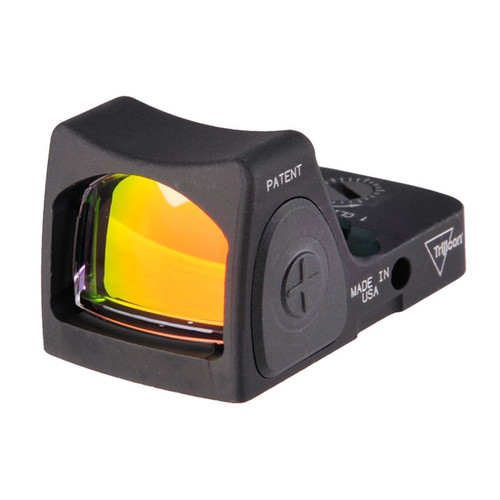
The forum answer is always "bigger dot = faster sight picture, smaller dot = more precise." That's not wrong, but it's not the whole answer. Pistol red dot dot size — measured in MOA, where 1 MOA covers roughly 1 inch at 100 yards — has to match the distance you actually shoot at, the size of the target you're trying to hit, and how much eye strain you can tolerate on a long range day. This guide picks dot sizes for carry, duty, competition, and precision based on the actual SKUs in our catalog so the decision is concrete.
What MOA Means on a Pistol
One MOA equals roughly 1 inch at 100 yards. At pistol distances the math is more useful in shorter units:
- 1 MOA dot covers ~0.25" at 25 yards, ~0.07" at 7 yards
- 3.25 MOA dot covers ~0.85" at 25 yards, ~0.24" at 7 yards
- 6 MOA dot covers ~1.57" at 25 yards, ~0.44" at 7 yards
- 8 MOA dot covers ~2.10" at 25 yards, ~0.59" at 7 yards
On a B-8 target at 25 yards, the X-ring is about 1.7" wide. A 6 MOA dot covers most of the X-ring at that distance — fast to find, but you can't see exactly where the dot is sitting inside the ring. A 3.25 MOA dot covers about half the X-ring; you can still pick up where the dot is inside it. A 1 MOA dot is a punctuation mark on top of the target — precise, but takes longer to find under stress.
That's the entire tradeoff. The right dot size depends on which side of it your shooting actually lives on.
Carry: 3.25–6 MOA
Concealed carry presentations happen at 3–15 yards under time pressure. You don't need precision past the bad guy's chest. You need the dot to be obvious — to show up in the window the instant the pistol comes up to eye level — without dominating the target so badly that you can't hit something specific if the situation calls for it.
The two best fits in the catalog:
- Trijicon RMR Type 2 RM06 — 3.25 MOA. This is the default carry dot for a reason. Big enough to acquire fast at carry distances, small enough to make a 25-yard headshot if you have to.
- Trijicon RMR Type 2 RM07 — 6.5 MOA. Faster acquisition for shooters who train mostly inside 10 yards or who struggle to find the dot under stress.
If you're new to red dots, start at 6 MOA and drop to 3.25 once you've trained the presentation enough that finding the dot is reflexive. Most shooters move down in dot size as their skill curve flattens.
Duty / Law Enforcement: 3.25 MOA
Duty pistols see longer engagement distances — patrol cars at 25 yards, hallway end-to-end shots in a residence, sometimes outdoor distances past 25 yards. 3.25 MOA is the duty sweet spot because it doesn't fully obscure a B-8 X-ring at 25 yards but is still fast enough at 7 yards.
This is why most agency-approved optic lists center on 3.25 MOA models: the Trijicon RMR RM06, the RMR HD 3.25 MOA, and the Aimpoint ACRO P2 (which uses 3.5 MOA — close enough to land in the same bucket). The Leupold DeltaPoint Pro 2.5 MOA sits just below the duty sweet spot — slightly more precise, slightly slower to acquire. It's a defensible choice for shooters who run their pistol at longer-than-average duty distances.
Competition: 6–8 MOA
Match shooting at USPSA, IDPA, and steel challenge distances is overwhelmingly inside 25 yards, on big targets, with the timer pushing speed over precision. Bigger dots win.
- Trijicon RMR Type 2 RM07 — 6.5 MOA
- Burris FastFire LLL — 8 MOA (with included Picatinny mount for pistol-caliber carbines)
At 8 MOA, the dot is roughly half an inch wide at 7 yards. That's massive in the optic window, which is exactly the point: you don't need to find it, it finds you. The downside is that anything past ~15 yards starts to feel imprecise — you're aiming with a blob, not a point — and the dot can wash out IPSC scoring zones at distance. Stay below 8 MOA if your matches include 25-plus-yard targets.
Precision / Pistol-Caliber Carbine: 1 MOA
Bullseye competition, PCC matches with 50-plus-yard targets, and any pistol-mounted optic that doubles as a glass on a chassis or PCC build benefits from 1 MOA.
The Trijicon RMR Type 2 RM09 — 1.0 MOA OD Green is the cleanest 1 MOA option in this footprint family. At 25 yards the dot covers a quarter inch; at 50 yards it covers half an inch. That's surgically precise — but it also means you must already be on target to find the dot quickly. New shooters with a 1 MOA dot end up searching for the dot in the window instead of seeing it immediately.
OD Green vs Red: for outdoor pistol-caliber carbine use, green tends to contrast better against natural backgrounds. Red works equally well indoors. Pick what your eyes prefer — the size matters more than the color.
Dot Size Picks From the Same Optic Family
Some optics ship in multiple dot sizes inside the same housing. That's the cleanest way to compare apples-to-apples without changing the optic platform.
Trijicon RMR Type 2 — Three Sizes, Same Footprint
- RM09 — 1.0 MOA OD Green — precision, PCC
- RM06 — 3.25 MOA Black — carry, duty
- RM07 — 6.5 MOA Black — competition, fast carry
Same RMR footprint across all three, so you can swap dot sizes on an RMR-cut slide without changing anything else.
Sig Romeo-RS — 3 MOA in Both Footprints
- Romeo-RS 3 MOA Compact Footprint — for P365 X-Macro and similar compact slides
- Romeo-RS Pro 3 MOA — for full-size Pro-footprint slides
3 MOA is essentially the same all-purpose carry/duty bucket as the 3.25 MOA RMR. The footprint difference matters more than the dot size difference here — pick based on what your slide is cut for.
Leupold DeltaPoint Pro — 2.5 MOA
The DeltaPoint Pro 2.5 MOA sits in the precision-leaning end of the carry bucket. Slightly more precise than a 3.25 MOA, slightly slower to acquire. If your shooting averages farther than 10 yards but doesn't reach competition distances, this is the dot that doesn't compromise either direction badly.
What About Bushnell, Burris, and Crimson Trace?
The lower price tier doesn't always give you a choice of dot sizes inside the same model line. The Burris FastFire LLL ships only in 8 MOA for example, which makes it ideal for pistol-caliber carbines and shotguns but oversized for typical carry pistol work. The Meprolight MPO-S Circle Dot uses a circle-dot reticle (3 MOA dot inside a 50 MOA ring), which is a different solution to the same problem: the ring helps you find the dot fast, the dot itself lets you aim precisely once you've found it. Worth considering if you can't decide between speed and precision.
Quick Decision Matrix
| Use Case | Dot Size | Best Picks |
|---|---|---|
| Concealed carry, new to red dots | 6–6.5 MOA | RMR RM07 |
| Concealed carry, experienced | 3.25 MOA | RMR RM06, Romeo-RS 3 MOA |
| Duty / LE | 3.25 MOA | RMR RM06, RMR HD 3.25, DeltaPoint Pro 2.5 |
| USPSA / IDPA / steel | 6–6.5 MOA | RMR RM07 |
| Pistol-caliber carbine | 1–3.25 MOA | RMR RM09, RMR RM06 |
| Bullseye / precision | 1 MOA | RMR RM09 |
| Outdoor, all-purpose with shotgun / PCC dual-duty | 8 MOA | Burris FastFire LLL |
The "Bigger is Faster" Myth — Where It Breaks Down
The argument for bigger dots is real: at close range, under time pressure, with adrenaline, a 6 MOA dot lights up the window faster than a 1 MOA dot. That's not in dispute.
Where it breaks down: as soon as you push past 15 yards, an 8 MOA dot starts to obscure scoring zones, then obscures the target itself. At 25 yards, an 8 MOA dot is roughly 2 inches wide — that's most of the head-sized target zone gone behind the dot. Your hits go where you think the center of the dot is, which adds a guessing step you don't have with a smaller dot. So "bigger = faster" is true at close range and false at distance, and the right answer depends entirely on which distance you actually shoot at most.
The honest middle ground: 3.25 MOA fits the largest range of pistol shooting use cases. If you have to pick one dot and never change it, that's the size. Drop to 1 MOA only if you have a specific precision need; jump to 6 MOA or larger only if your matches and training are inside 15 yards.
Where to Go From Here
If you haven't decided on a footprint yet, start with our pistol red dot footprint guide first — the footprint controls which optics will physically mount to your slide, so it has to come before dot size. Once you know the footprint, browse the pistol optics category filtered by Compatibility and pick the dot size that fits how you actually use the pistol.