
Two thread pitches cover almost every AR-15 and AR-10 barrel you will encounter: 1/2x28 and 5/8x24. Picking the wrong one is the most common reason a muzzle device arrives and will not thread on.
Most guides stop at "check your barrel." This one explains why the two pitches exist, which calibers use which, and what actually interchanges once you know your thread.
Why Two Pitches Exist
Thread pitch is a function of bore diameter. A muzzle thread has to leave enough steel between the bore and the outside of the barrel to hold torque without cracking.
On a .224-inch bore there is plenty of shoulder left at a 1/2-inch major diameter, and a fine 28-threads-per-inch pitch holds well. Open the bore up to .308 inches and a 1/2-inch thread would cut dangerously close to the rifling, so the standard steps up to a 5/8-inch major diameter with a slightly coarser 24 TPI.
That is the whole logic. Bigger bore, bigger thread. The numbers are not arbitrary and they are not brand preferences — they are industry standards, which is why devices interchange so freely within a pitch.
Caliber to Thread Pitch
| Caliber | Standard pitch | Notes |
|---|---|---|
| 5.56 NATO / .223 Rem | 1/2x28 | The AR-15 default |
| .22 LR | 1/2x28 | Same pitch, much lower pressure |
| 9mm (AR carbine) | 1/2x28 | Also common on 9mm pistols |
| 300 Blackout | 5/8x24 or 1/2x28 | Both exist — see below |
| .308 Win / 7.62 NATO | 5/8x24 | The AR-10 default |
| 6.5 Creedmoor | 5/8x24 | |
| 6mm ARC | 5/8x24 | Despite the smaller bore |
| .450 Bushmaster | 11/16x24 | Neither standard — verify |
The 300 Blackout exception
300 Blackout is the one caliber that genuinely runs both. Its .308-inch bore would ordinarily call for 5/8x24, and plenty of barrels ship that way. But 300 Blackout is built on a 5.56 case and runs in AR-15 uppers, so many manufacturers thread it 1/2x28 deliberately — it lets one suppressor serve both a 5.56 host and a 300 Blackout host.
That is a real convenience, and it is also why you cannot assume the pitch from the caliber stamp on a 300 Blackout barrel. Measure or check the spec sheet. Our guide to which AR-15 parts interchange between 300 Blackout and 5.56 covers the rest of the shared-component picture.
How to Identify What You Have
In rough order of reliability:
- The manufacturer's spec sheet. Barrel makers publish thread pitch. This is the answer, and it takes thirty seconds.
- The thread protector already on the barrel. Most threaded barrels ship with one, and it is cut to the barrel's pitch. If you still have it, you have your gauge.
- A thread pitch gauge. Cheap, definitive, and worth owning if you build more than occasionally.
- Caliper measurement of the major diameter. Roughly 0.50 inch means 1/2x28; roughly 0.625 inch means 5/8x24. This distinguishes the two standards but will not catch an oddball.
What does not work: threading a device on and seeing whether it "feels right." A 1/2x28 device will start onto a 5/8x24 barrel and cross-thread, and you can damage both parts before you realize.
What Interchanges Once You Know the Pitch
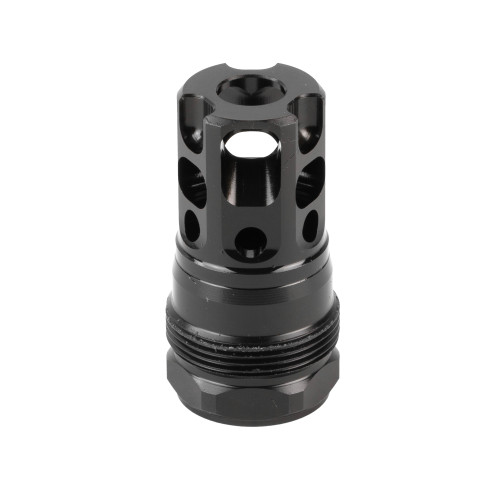
Within a pitch, muzzle devices are broadly interchangeable across the category. A 1/2x28 flash hider, brake, or compensator will thread onto any 1/2x28 barrel regardless of who made either part.
Threading on is not the same as being rated for the cartridge. This is the distinction that matters for safety. A 1/2x28 device designed for 5.56 will thread onto a 1/2x28 300 Blackout barrel — but the bore through the device may be sized for .224-inch projectiles, and a .308-inch bullet passing through it is a baffle strike. Always confirm the device's rated caliber, not just its threads.
1/2x28 options
- Steel 1/2x28 muzzle brake and flash hider — the budget entry point, and a reasonable default on a general-purpose carbine.
- Troy Claymore muzzle brake — 1/2x28, rated for 5.56 NATO, with the aggressive side-venting that makes brakes effective and loud in equal measure.
- Fortis Red STS muzzle brake — a mid-tier 5.56 brake for shooters who want measurable recoil reduction without stepping up to a competition device.
- A2 birdcage flash hider — the reference standard, and still hard to beat on value for a low-light carbine.
5/8x24 options
- LPM Liberty Bell muzzle brake — 5/8x24 for .30 caliber, a straightforward choice for an AR-10 or a 5/8x24 300 Blackout build.
- YHM SRX muzzle brake — 5/8x24, and part of a suppressor-mount ecosystem if you plan to run a can later.
The full range is in the muzzle devices category.
A Few Practical Notes
Crush washers and shims. Timing matters on any device that is not radially symmetric — a brake with side ports has to end up level. A crush washer is the common solution; shims give finer control. Neither changes thread pitch compatibility.
Thread length varies. Pitch is only half the spec. A barrel with a short threaded section may not let a long device seat against the shoulder, which is where the device actually gets its support.
Suppressor mounts are their own standard. Many suppressors mount to a proprietary muzzle device rather than directly to the barrel threads. If a can is in your future, choose the muzzle device inside that system rather than buying twice.
Suppressor ownership is federally regulated and state laws vary. Verify local regulations before purchasing.
The Bottom Line
5.56 and .223 are 1/2x28. .308, 7.62 NATO and 6.5 Creedmoor are 5/8x24. 300 Blackout is whichever the maker chose, so look it up rather than assuming.
Once the pitch is settled, the remaining question is which type of device you want — a flash hider, a brake, or a compensator do three different jobs, and the right answer depends entirely on how you shoot. We break that decision down in our muzzle device overview.