

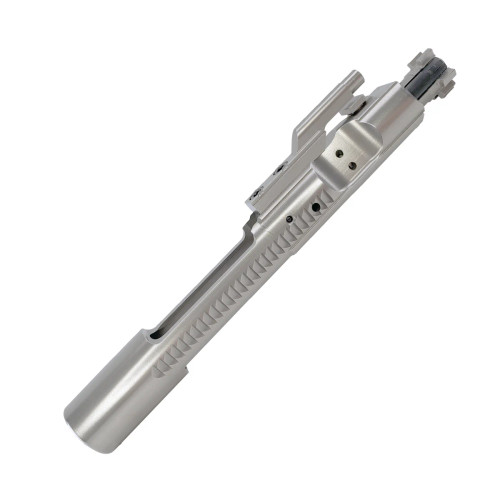
If you already own a 5.56 AR-15 and you're eyeing 300 Blackout, the real question is what you can keep and what you have to replace. The answer is cleaner than most forum threads make it: your bolt carrier group, lower, buffer, and magazines all carry over. Only the barrel and gas system change. Everything else about a 300 BLK upper is identical to your 5.56 rifle.
The short answer: what interchanges and what doesn't
300 AAC Blackout was designed around the 5.56 platform on purpose. The goal was a .30-caliber cartridge that ran in an unmodified AR-15 with only a barrel swap, delivering better short-barrel and suppressed performance without a new magazine, bolt, or lower. The cartridge uses a 5.56 case shortened and necked up to hold a .30-caliber bullet, so it shares the same case head diameter. That single design choice is why the bolt face, magazines, and the entire lower half of the rifle work across both calibers without modification.
| Part | Interchangeable? | Notes |
|---|---|---|
| Lower receiver | Yes | Identical. No caliber-specific parts. |
| Buffer & buffer tube | Yes | Same carbine tube and buffer work; tuning is optional, not required. |
| Bolt carrier group / bolt | Yes | Same 5.56 bolt face. .223/5.56 and 300 BLK share the case head. |
| Charging handle | Yes | No difference. |
| Magazine | Yes | Standard AR-15 (STANAG) magazines feed both. See notes below. |
| Barrel | No | Caliber-specific. A 300 BLK barrel is bored and chambered for .30 cal. |
| Gas system | Changes with barrel | 300 BLK typically runs pistol-length gas, especially on short barrels. |
| Muzzle device | Usually | Both commonly use 1/2x28 threads, but bore diameter differs, verify caliber rating. |
Can you use your 5.56 BCG for 300 Blackout?
Yes. This is the most-searched 300 BLK question and the answer is unambiguous: a standard 5.56/.223 bolt carrier group runs 300 Blackout with no changes. The bolt's extractor and ejector grip the same rim, and the bolt face headspaces on the same case base. You do not need a dedicated "300 BLK bolt."
Because the two calibers share a bolt, a multi-caliber-marked BCG is a smart buy if you plan to run both calibers off one lower. Our Polished Nickel Boron BCG rated for 5.56/.223/300 BLK and the value-priced .223/5.56/300 BLK Nickel Boron BCG are both cut for all three chamberings, so one carrier moves between uppers. The nickel boron finish also wipes clean easily, which helps with the heavier carbon fouling that subsonic 300 BLK loads tend to leave behind.
What actually changes: the barrel and gas system
The barrel is the only part that is genuinely caliber-specific. A 300 Blackout barrel has a .30-caliber bore and a chamber cut for the 300 BLK case, versus the .224 bore of a 5.56 barrel. You cannot fire 300 BLK through a 5.56 barrel, and doing so is dangerous (more on that below).
Gas system length follows the barrel. 300 Blackout was engineered to run short and to cycle reliably suppressed, so most 300 BLK barrels, especially 8- to 10.5-inch options, use a pistol-length gas system. A 16-inch 300 BLK barrel may use carbine-length gas. The gas port and gas block come matched to the barrel, so when you buy a 300 BLK barrel you are effectively buying the correct gas length with it. If you are shopping complete uppers or bare barrels, browse the Barrels and Parts category and confirm the caliber marking before you order.
Twist rate is the other barrel spec worth noting. 5.56 barrels commonly run 1:7 or 1:8. 300 Blackout barrels favor a faster twist — most commonly 1:7, sometimes 1:8 — because heavy subsonic .30-caliber bullets (200 to 220 grains) need the extra spin to stabilize. If you shoot mostly subsonic, favor 1:7. This is a barrel-selection consideration only, it does not affect whether your BCG, lower, or mags carry over.
Do 300 Blackout and 5.56 use the same magazines?
Yes. Standard AR-15/STANAG magazines feed both cartridges. Because 300 BLK is loaded to roughly the same overall length as 5.56, it stacks and feeds from the same followers and bodies. PMAGs, aluminum GI mags, and steel mags all work.
Two practical notes. First, the .30-caliber bullet is fatter, so a magazine rated for 30 rounds of 5.56 will hold slightly fewer 300 BLK rounds before the spring is fully compressed, though most run a full 30 without issue. Second, and more important: because both cartridges drop into the same magazine, it is physically possible to load 300 BLK into a magazine sitting next to your 5.56 rifle. That is exactly how the dangerous mistake below happens. Many shooters mark their 300 BLK magazines to keep them separated.
Does 300 Blackout need a different buffer or recoil spring?
No, not to function. Your existing carbine buffer and spring will cycle a 300 BLK upper. Buffer weight is a tuning lever, not a compatibility requirement, which is why it sits in the "interchangeable" row above.
Where tuning helps is reliability across supersonic and subsonic loads, particularly when you add a suppressor. Subsonic 300 BLK produces less gas, so a lighter buffer can help the action cycle fully unsuppressed, while a suppressor adds back-pressure that can make the rifle run harder and eject violently, where a heavier buffer smooths things out. Many 300 BLK shooters settle on an H or H2 buffer as a compromise, or run an adjustable gas block. None of that is required to get started, a standard carbine buffer works, but it explains why you will see buffer-weight debates attached to every 300 BLK thread.
The one warning that matters: 300 BLK in a 5.56 chamber
This is the safety issue every serious 300 Blackout buyer needs to understand. A 300 BLK cartridge will chamber in a 5.56 barrel. The case base is identical, so the round slides in and the bolt closes on it. Nothing stops you at the trigger.
If you fire it, you are driving an oversized .30-caliber bullet down a .224-inch bore. The pressure spike is catastrophic and routinely destroys the barrel, the upper, and sometimes the entire rifle, with a real risk of injury. This is one of the most common and most damaging kabooms in the AR world, and it happens precisely because so much of the platform interchanges.
The reverse is safer by accident: a 5.56 round generally will not fully chamber in a 300 BLK barrel because the longer 5.56 case shoulder stops it, so the bolt will not close and the rifle will not fire. But do not rely on that as a safety system. The rules that actually keep you safe:
- Never mix 300 BLK and 5.56 ammunition on the same bench or in the same range bag.
- Dedicate and mark magazines to one caliber, and keep them physically separated.
- Verify the caliber roll-marked on the barrel before every session, especially if you swap uppers.
- Keep clearly labeled uppers — a 300 BLK upper and a 5.56 upper look identical from the outside.
Switching an existing 5.56 rifle to 300 Blackout
Because the lower, buffer, BCG, charging handle, and magazines all carry over, moving to 300 Blackout is a caliber decision made at the upper. The cleanest path is a second complete upper: keep your 5.56 upper, add a 300 BLK upper, and share the same lower. That approach also sidesteps the ammo-mixing risk, since a dedicated 300 BLK upper is easy to store and label separately. A multi-caliber BCG like the ones above lets you keep a single carrier if you would rather buy the barrel and gas components on their own from the BCG, Bolts and Parts catalog and matching barrel section.
Whichever route you choose, the takeaway is the same: 300 Blackout was built to bolt onto the AR-15 you already own. The bolt, lower, buffer, and mags stay, the barrel and gas system change, and clear caliber discipline keeps the two safely apart.
Quick reference: 300 BLK vs 5.56 at a glance
- Same bolt face: one 5.56/.223/300 BLK-marked BCG runs both.
- Same lower, buffer, and magazines: nothing below the barrel changes.
- Different barrel and gas length: the only true caliber-specific parts.
- Critical warning: a 300 BLK round chambers in a 5.56 barrel and will destroy the rifle if fired. Separate your ammo and mags.
Ready to build or add a caliber? Start with a multi-caliber carrier from the BCG, Bolts and Parts category, then match it to the right barrel in Barrels and Parts, and label your uppers before the first range trip.