

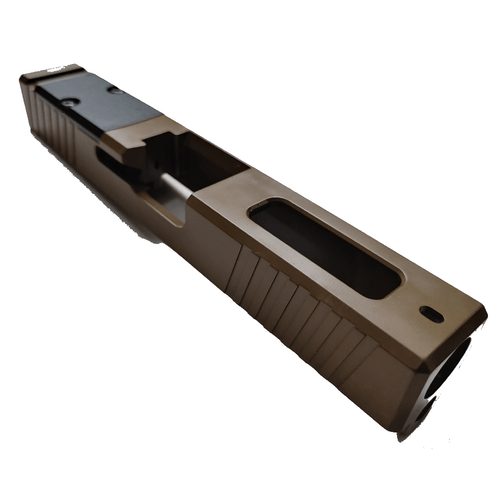
You finished swapping slides on your Glock, racked it, and the slide stopped a hair short of fully closing. Or worse — it closes under recoil at the range and hangs up on the next round. The pistol isn’t “broken.” Almost every out-of-battery issue after an aftermarket slide swap comes down to one of five causes, and none of them require gunsmithing to diagnose.
This is a plain-English guide to what’s actually going on, so you know what to check (or what to ask for) before you assume you bought a bad part.
First, what does “out of battery” actually mean?
A semi-auto pistol is “in battery” when the slide is fully forward, the barrel is locked up against the slide, and the chamber is sealed behind the cartridge. Anything less — even a few thousandths of an inch — and the gun either won’t fire or shouldn’t fire. On a Glock, you’ll usually notice one of these symptoms:
- The slide stops about 1/8″ to 1/4″ short of fully forward and you have to tap it closed.
- The trigger feels dead or spongy when you try to fire.
- Brass ejects oddly, or the next round nose-dives into the feed ramp instead of chambering.
If you’re getting any of that after an aftermarket slide swap, start with the five causes below, in order of how often they’re the culprit.
Cause #1: The slide hasn’t been broken in yet
This is the single most common reason a new aftermarket slide won’t return fully to battery, and it’s almost always misdiagnosed as a defect. A freshly machined slide has tight tolerances and surface finishes that need a break-in period before the slide and frame rails mate up and the barrel settles into lockup. During that window, the slide runs stiffer than it will in another 200–500 rounds, and a hand-racked round — which doesn’t have the energy of a live recoil cycle behind it — can fail to fully seat.
The fix is boring but reliable: shoot it. A proper break-in procedure gets the slide, barrel, and recoil assembly wearing in together the way they’re designed to, and the vast majority of “it won’t close all the way” complaints disappear after the first range session.
We’ve got a step-by-step guide to the exact break-in routine we recommend for every aftermarket slide we ship — read it first before you diagnose anything else: Breaking in a New Slide.
If you’ve already run a couple hundred rounds through the new slide and it still won’t seat, work down the list.
Cause #2: Recoil spring weight is wrong for the new slide
Factory Glock recoil spring assemblies are tuned for the weight of the factory slide. When you drop on an aftermarket slide, the slide mass changes, and the spring weight that worked before may now be too light or too heavy.
Two patterns to watch for:
- Lightweight/windowed slide with a stock spring: the slide is lighter than what the spring was designed to move, so the spring rides the slide home too aggressively and can short-stroke on chambering a fresh round.
- Heavier slide (steel-heavy optic cut, added RMR, compensated front) with a stock spring: the spring doesn’t have enough force to push the heavier slide the last fraction of an inch into lockup, especially on the first chambered round when the slide is hand-racked instead of driven by recoil.
The fix is a different recoil spring weight. Most aftermarket slide manufacturers will list a recommended spring weight for their product; follow that first. If the manufacturer doesn’t publish one, start one weight step away from factory and test.
If you don’t already have a spare assembly on hand, replacement recoil springs are part of any Glock parts kit or can be bought as a standalone part.
Cause #3: Barrel hood fit is too tight against the slide
The barrel hood is the rear upper portion of the barrel that fits up into the ejection port and locks against the front of the slide. On a stock Glock, that fit is loose on purpose — Glock factory tolerances are generous, which is why they run dirty. Aftermarket barrels are usually cut tighter for better lockup and accuracy, and that tighter fit is exactly what can stop a slide from returning fully to battery.
Two things to check:
- Hood-to-breech-face contact: if the rear of the hood is pressing against the slide’s breech face too hard, the slide can’t seat. You’ll often see a bright rub mark on the top rear of the hood after a few attempts to close the slide.
- Hood-to-ejection-port sides: side-to-side contact inside the ejection port keeps the barrel from tilting up into full lockup.
A barrel that fits perfectly in one slide may not fit another. If you bought a barrel and slide separately, this is the most common reason they don’t play nicely. Pairing a barrel to a specific aftermarket slide — or buying them together — avoids the issue entirely. Our Glock barrels are sized for standard Glock slide geometry, and every assembled Glock slide we ship is test-fit with its barrel before it leaves the shop.
Cause #4: Extractor tension or fit
The extractor is the small hook on the right side of the breech face that grips the rim of the cartridge. If extractor tension is too high, or if the extractor is seated too far inward, it can bind against a chambered round and keep the slide from closing the last fraction of an inch.
This one tends to show up when:
- You reused a factory extractor in a new aftermarket slide and the internal geometry isn’t identical.
- You installed a new extractor and the extractor depressor plunger spring is stiffer than factory.
- The round itself has a slightly out-of-spec rim (common with mixed reman ammo).
A quick diagnostic: drop a single round directly into the chamber (don’t feed it from the magazine) and ease the slide forward. If the slide closes fully on a manually chambered round but hangs up on a mag-fed round, the extractor is the likeliest suspect.
Cause #5: Dirty, dry, or debris-packed slide rails
Before you order any new parts, rule this one out. Glocks run dirty for a long time, but a brand-new aftermarket slide has a machined finish that can hold manufacturing residue, packaging oil, or grit in the rails. Combine that with a stiff new recoil spring and the slide will move a little slower than it should.
Strip the slide off the frame, wipe both sets of rails clean, re-lube lightly per Glock’s factory spec (four small oil points on the rails and one on the barrel hood), and try again. If the slide now goes into battery reliably, that was the cause. If it still hangs up, work through causes 1–4 above.
How to figure out which one it is, fast
Use this order:
- Run the break-in routine if the slide is new — full procedure here. This resolves the majority of cases.
- Clean and lube the slide and frame. Five minutes.
- Single-round chamber test — if it closes on a hand-dropped round but fails on a mag-fed round, look at the extractor.
- Visual hood check — look for rub marks on the top or sides of the barrel hood.
- Spring weight check last — because it’s the part you’re most likely to need to buy, rule out the free fixes first.
Most slide-swap issues are fixed in step 1 or step 2. The ones that aren’t usually come down to a spring weight mismatch, which is a $15 part, not a defective slide.
Skip the guesswork
If you’d rather not troubleshoot, the simplest path is an assembled slide that ships with its barrel and recoil assembly already matched and test-fit. Browse our assembled Glock slides — each one is built, fit, and function-checked before shipping, which eliminates causes 2, 3, and 4 from the jump.
Parts that fix return-to-battery issues
DISCLAIMER: “GLOCK” is a federally registered trademark of GLOCK, Inc. and is one of many trademarks owned by GLOCK, Inc. and GLOCK Ges.m.b.H. Neither 3CR Tactical nor this site are affiliated in any manner with, or otherwise endorsed by, GLOCK, Inc. or GLOCK Ges.m.b.H. The use of “GLOCK” on this page is merely to advertise the sale of GLOCK pistols, parts, or components. For additional genuine GLOCK, Inc. and GLOCK Ges.m.b.H products and parts visit www.glock.com.