

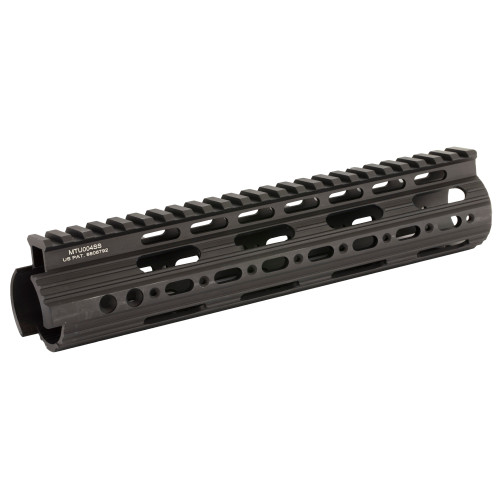
If you bought a free-float handguard and then discovered it didn't come with an installation tool — or that the barrel nut doesn't work with your current upper — you've encountered one of the most confusing but easily solved problems in AR-15 building.
This article covers the mechanical side: what barrel nut types exist, how they differ, what you need to install each, and how rail standards affect what accessories you can run. Read it before you buy a free-float handguard.
Why Barrel Nuts Matter
The barrel nut is the threaded ring that clamps the barrel to the upper receiver. In the standard AR-15, a single mil-spec barrel nut (1.25" OD, 8-28 TPI) handles this job. The delta ring, weld spring, and snap ring assembly sits on the barrel nut and provides the mounting point for drop-in handguards.
When you install a free-float handguard, you're replacing the delta ring assembly with the handguard itself. The handguard needs its own barrel nut — one that its front end can thread or clamp onto. Different manufacturers use different barrel nut designs, which is where the variability comes in.
Mil-Spec Compatible Barrel Nuts
The most installer-friendly free-float handguards use a barrel nut with the same outer profile as the standard mil-spec nut. This means:
- A standard AR armorer's wrench (accepting the standard 8-position castle nut pattern) will install it
- Torque spec is typically 30-80 ft-lbs, aligned so one of the nut's notches lines up with the gas tube hole
- No special tools, no proprietary hardware
Midwest Industries and Presma handguards in our catalog both use mil-spec compatible barrel nuts. If you already own a standard armorer's wrench, you have everything you need.
Proprietary Barrel Nuts
Many premium handguard brands use proprietary barrel nuts that require their own installation tools. The nut may be a different diameter, use a spanner-style interface, or require an alignment pin tool.
These systems work well, but the cost of ownership includes the installation tool (often $30-60 separately) or a gunsmith who has it. If you're building your own rifle and don't want brand-specific tools, stick to mil-spec compatible barrel nuts.
Torque and Gas Tube Alignment
This is the step that trips up first-time installers. A free-float barrel nut must be torqued into the correct position — not just torqued to spec. The gas tube runs from the gas block, through the handguard, and back through the barrel nut into the receiver. One of the barrel nut's notches must align with that gas tube hole.
Process:
- Apply Rocksett (threadlocker rated for 500°F+) or Loctite 272 to the barrel extension threads
- Thread the barrel nut hand-tight
- Begin torquing. At 30 ft-lbs, check if any notch aligns with the gas tube hole
- Continue torquing until a notch aligns AND you're within 30-80 ft-lbs (never back off to align — always torque forward to the next notch)
- Install the gas tube before sliding on the handguard body
Rail Standards: M-LOK, KeyMod, and Picatinny
Once the barrel nut is sorted, you're choosing how to attach accessories to the handguard body.
M-LOK is the current industry standard. Attachments use a T-nut that rotates 90 degrees to lock into the slot. Under lateral load testing, M-LOK consistently outperforms KeyMod in retention. New handguard production has largely moved to M-LOK, and accessory selection is now broader than KeyMod across every category.
KeyMod uses a keyhole-shaped slot — insert through the larger round portion and slide back to lock. Still widely supported, but new production has largely shifted away. Existing KeyMod accessories still work and there's no urgency to change if you're already set up on it.
Picatinny (MIL-STD-1913) is a continuous 1913 rail. Universal compatibility — every accessory designed for tactical use fits without adapters. Heavier than either slot system but unbeatable for compatibility breadth. If you're running mixed gear from multiple manufacturers and want certainty, Picatinny is the safe choice.
Upper Receiver Compatibility
The barrel nut threads onto the upper receiver. Mil-spec forged uppers use standard threading — every standard barrel and barrel nut threads in cleanly. Billet uppers from manufacturers like Spike's Tactical and Nordic Components use the same threading and are fully compatible with mil-spec barrel nuts.
Where you can run into issues is on non-standard uppers with tighter or looser threading tolerances. If you're buying a stripped upper to pair with a new free-float handguard, mil-spec dimension uppers guarantee clean barrel nut installation with standard tools.
What You'll Need for a Free-Float Install
- Armorer's wrench (for mil-spec compatible barrel nuts)
- Rocksett or Loctite 272 (threadlocker rated for high heat)
- Torque wrench capable of 80 ft-lbs
- Vice block to hold the upper receiver stationary
- Gas tube alignment tool (optional but helpful for first-timers)
Upper and Handguard Options at 3CR Tactical
- Spike's Tactical M4 Multical Forged Upper Receiver — mil-spec forged, accepts any standard barrel and free-float barrel nut, clean threading for reliable installation
- Nordic Components NC15 Black Extruded Upper Receiver — billet-style extruded upper, mil-spec threading, pairs with any mil-spec compatible handguard
- Presma M-LOK Free Float Handguard with Integrated Hand Stop — mil-spec compatible barrel nut, installs with a standard armorer's wrench, hand stop built in to save a separate purchase
If you're pairing a new upper with a new free-float handguard, both the Spike's and Nordic options are confirmed mil-spec dimension — installation is straightforward with standard tools and no surprises at the barrel nut step.