

Pick the wrong AR-15 buffer weight and the rifle tells on you: brass thrown three feet forward, a bolt that short-strokes on cheap ammo, or a snappy recoil impulse that fights your follow-up shots. Buffer weight is the cheapest, most reversible way to tune how an AR runs, but the "use the heaviest buffer that still cycles reliably" rule everyone repeats only works once you understand what carbine, H, H2, and H3 actually mean and which barrel and gas combination each one belongs on.
What the buffer weight actually controls
The buffer rides behind the bolt carrier inside the receiver extension (buffer tube) and works against the action spring. When the rifle fires, gas drives the carrier rearward, the carrier shoves the buffer back, and the spring returns the whole assembly to strip and chamber the next round. Buffer mass sets how much resistance the carrier meets on that rearward trip.
A heavier buffer slows the carrier down. That does three useful things when the system is overgassed: it lowers bolt-carrier velocity, softens the felt recoil impulse, and reduces the violence of the carrier slamming the back of the tube. Go too heavy for the gas the barrel actually delivers and the carrier no longer travels far enough or fast enough to reliably pick up the next round, and you get short-stroking. The goal is balance, not maximum mass.
Carbine, H, H2, and H3 buffer weights explained
A standard AR-15 carbine buffer is a hollow aluminum body holding three sliding internal weights and separated by rubber bumpers. The "H" designations swap those steel weights for tungsten, which is far denser, so each substitution raises mass without changing length or fit. Every one of these drops into the same carbine-length receiver extension.
- Carbine (standard): about 3.0 oz. Three steel weights. The baseline most complete lowers ship with.
- H (H1): about 3.8 oz. One steel weight replaced with tungsten.
- H2: about 4.6–4.7 oz. Two tungsten weights.
- H3: about 5.0–5.4 oz. Three tungsten weights — the heaviest common carbine-length option.
The jump from carbine to H is roughly 0.8 oz, and each step up adds a similar increment. Those are small numbers on a kitchen scale but meaningful to a system moving at the speeds an AR bolt carrier sees. You do not need exotic hardware to move between them — the weights are the only thing that changes.
Which buffer for which barrel and gas system?
Buffer choice is downstream of gas. The gas port size, gas system length, and barrel length together decide how hard the carrier gets driven, and the buffer's job is to meet that force. Longer gas systems on a given barrel length lower port pressure and soften the impulse; shorter systems and larger ports raise it. Use these as informed starting points, then confirm with live-fire and your ejection pattern.
- 16" barrel, carbine-length gas (unsuppressed): Carbine gas on a 16" barrel is inherently overgassed. Start at H or H2. Most 16" carbine-gas builds run best on H2.
- 16" barrel, mid-length gas (unsuppressed): Mid-length lowers port pressure, so a carbine or H buffer is the usual sweet spot. Reach for H2 only if brass ejects violently forward.
- 14.5"–16" barrel, carbine gas, suppressed: A can adds back pressure and drives the carrier harder. Step up to H2 or H3 to tame it.
- 11.5"–12.5" barrel, carbine or pistol-length gas: Short barrels with short gas systems run at high pressure. Start at H2; suppressed short barrels often want H3.
- 18"–20" barrel, rifle-length gas: These run softer and typically live on a rifle-length buffer in a fixed stock, or a carbine H in a collapsible setup. Do not over-buffer a low-pressure rifle-gas system or you will short-stroke it.
The pattern is consistent: more gas (shorter systems, larger ports, suppressors) wants more buffer; less gas wants less. If you are still choosing a barrel or matching a gas length, get that decision right first — browse the Barrels and Parts category and pair the gas system to the length before you finalize a buffer.
Read your ejection pattern to confirm the weight
Your brass is a free diagnostic. Fire a magazine of consistent ammunition, note where the empties land relative to your shooting position (think of a clock face, muzzle pointed at 12), and read it against this checklist. Confirm over several magazines and with the ammo you actually run, since weak or hot loads shift the picture.
- Brass at 3:00–4:00, landing in a tidy pile: The system is tuned. Leave it alone.
- Brass thrown far forward toward 1:00–2:00: Overgassed. The carrier is moving too fast — go up a buffer weight (carbine to H, H to H2).
- Brass landing consistently at 4:30–5:00: On the late side of ideal. If the rifle runs 100% reliably, it is fine to leave alone; if you want ejection closer to 3:00–4:00, a lighter buffer nudges the timing earlier. Adding weight pushes ejection later, not forward — so don’t go heavier here.
- Brass dribbling to 4:00–5:00 weakly, stovepipes, or bolt not locking back on an empty mag: Undergassed or over-buffered. Drop a buffer weight before you touch anything else.
- Failure to feed or short-stroking: The carrier is not traveling far enough. A lighter buffer is the first, cheapest fix.
Ejection reading is a directional tool, not a lab measurement. Ambient temperature, magazine spring condition, and lubrication all move the numbers a little — but a rifle throwing brass to 1:00 is telling you something real, and buffer weight is the right lever to pull.
Where a sound-mitigating buffer fits in
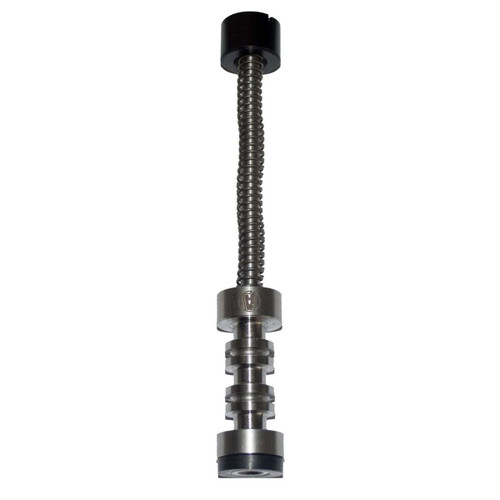
Standard H-series buffers change mass but still let the internal weights bounce, which contributes to the metallic "ping" and bolt bounce some shooters feel. A dead-blow or captured-spring design like the Armaspec SMB-C Sound Mitigation Buffer uses an internal captured system to arrest that bounce, smoothing the impulse and quieting the action without forcing you to commit to one fixed weight the way a plain tungsten buffer does. It drops into any carbine-length tube exactly like a standard buffer, so it is a straightforward upgrade path for a build that already cycles but feels harsh.
These are a refinement, not a fix for a mis-tuned gas system. Sort out gross overgassing with the right H-weight and gas selection first; add a sound-mitigating buffer when you want to polish an already-reliable rifle.
Buffer tube spec: carbine vs rifle length
Buffer weight only matters if the buffer physically fits your tube, and this is where returns happen. There are two incompatible standards, and the buffer, spring, and receiver extension must all match.
- Carbine (collapsible stock): Uses a shorter receiver extension, a carbine buffer (carbine/H/H2/H3), and a carbine action spring. This is what the overwhelming majority of modern AR-15s run.
- Rifle length (fixed A1/A2 stock): Uses a longer receiver extension, a longer rifle buffer, and a rifle spring. Carbine buffers do not belong here and vice versa.
If you are assembling a collapsible-stock build from parts, a complete kit removes the guesswork by matching the tube, spring, castle nut, and end plate to a carbine buffer. The LBE Mil-Spec Buffer Tube Kit is a straightforward complete carbine assembly, and the full AR Buffer Tubes and Kits category covers the other lengths and finishes if your build calls for something specific. Confirm carbine versus rifle before you order — a mismatched tube and buffer is the single most common cause of a "my new buffer won't fit" support ticket.
Pair the buffer to the carrier it works against
Buffer weight and bolt-carrier group work as a pair. A full-mass M16-profile carrier (the standard for reliability) is already accounted for in the weight recommendations above; a lightweight or "low-mass" carrier changes the math and usually pairs with a lighter buffer and an adjustable gas block. If you are building fresh or upgrading, spec a full-mass carrier such as the Faxon M16 5.56 Bolt Carrier Group and tune buffer weight around it — that combination is what the carbine/H/H2/H3 guidance assumes. The broader BCG, Bolts and Parts category has full-mass options across coatings if you want to match finish to the rest of the build.
Common buffer weight questions
Is a heavier buffer always better? No. Heavier is better only up to the point where the carrier still cycles with full authority on your weakest ammunition. Past that you trade reliability for a marginally softer impulse, and a rifle that short-strokes in a defensive moment is a bad trade. Tune to the heaviest weight that still locks the bolt back reliably, then stop.
Can I just add an adjustable gas block instead of changing buffers? An adjustable gas block and buffer weight are complementary tools, not substitutes. The gas block meters how much gas reaches the carrier at the source; the buffer manages the momentum that gas creates. Serious tuners often set a sensible buffer weight first, then trim excess gas at the block for the final polish. For most builds, getting the buffer weight right handles the majority of the problem on its own.
Will one buffer work across seasons and ammo? A slightly heavier buffer that reliably cycles your weakest winter load will also handle hot summer ammo — it just runs a touch softer in the heat. If you shoot a wide spread of ammunition, tune to the weakest load so the rifle never short-strokes, and accept a marginally firmer impulse on the hot stuff.
The short version
Start from your gas system, not from a spec sheet: mid-length 16" runs light (carbine or H), carbine-gas 16" runs heavier (H2), short barrels and suppressed guns run heaviest (H2–H3), and low-pressure rifle-gas builds want less buffer, not more. Then let your brass confirm it — forward and far means go heavier, weak and short means go lighter. Get the tube standard right first, match the buffer to a full-mass carrier, and you will have a rifle that cycles clean and shoots flat. Build your carbine system with a complete buffer tube kit and dial the impulse in from there.