
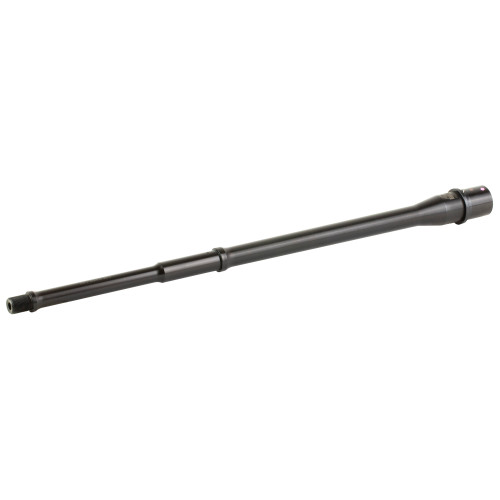
Barrel profile is the contour of an AR-15 barrel — the amount of steel left along its length — and it decides how much your rifle weighs, how fast it heats up, and where it balances. It is a separate spec from barrel length. A 16-inch barrel can weigh anywhere from about 1.5 pounds to over 2.5 pounds depending on its profile, and that difference is felt every time you shoulder the rifle. This guide breaks down the common profiles — Pencil, Government, M4, SOCOM, Gunner, SPR, and Bull/HBAR — and matches each to the kind of shooting it actually suits.
What is a barrel profile, and how is it different from length?
Length is the distance from the chamber to the muzzle. Profile is the outer diameter of the barrel at each point along that length — how much material sits under the handguard. Two 16-inch barrels with the same twist rate and gas system can handle completely differently because one is a thin Pencil and the other a heavy Bull.
Profile drives three things: weight (more steel means more ounces out front), heat capacity (a heavier barrel absorbs more heat before groups open up), and balance (thin barrels feel lively and point fast; heavy barrels sit steady off a bag). Every profile is a compromise between those three. There is no "best" contour — only the right one for how you shoot.
Pencil profile: the lightweight option
A Pencil barrel is thinned down as far as the manufacturer dares, usually around 0.625 inches under the handguard. A 16-inch Pencil weighs roughly 1.4 to 1.6 pounds — the lightest mainstream option and a favorite for patrol carbines, lightweight builds, and anyone who carries the rifle more than they shoot it from a bench.
The tradeoff is heat. A Pencil holds less thermal mass, so sustained rapid fire will heat it faster and shift point of impact sooner than a heavier contour. For hunting, defense, and general range use where you are not dumping magazines back to back, that rarely matters. The reward is a rifle that swings quickly and carries all day without wearing you out.
Government and M4 profile: the mil-spec middle ground
The Government profile is the classic contour: thin behind the gas block, then stepping up to a heavier section toward the muzzle. The M4 profile is nearly identical but adds the M203 grenade-launcher cut — a machined relief notch under the front of the barrel. Functionally, for a civilian rifle, Government and M4 shoot the same and land in the same weight class, around 1.9 to 2.1 pounds at 16 inches.
This is the most common contour on factory carbines because it is a proven all-rounder: enough mass to shrug off normal strings of fire, familiar handling, and a price that reflects volume production. A quality M4-contour barrel like the Rosco Bloodline 16" M4 5.56 NATO barrel is the default answer for a general-purpose 16-inch build — it does nothing badly. The one quirk worth knowing: the heavy-front, thin-rear layout puts the weight toward the muzzle, so a Government/M4 barrel feels slightly more nose-heavy than its total weight suggests.
SOCOM profile: heavier under the handguard
The SOCOM contour keeps a fatter, more consistent diameter through the mid-section of the barrel rather than thinning it out behind the gas block. It was developed to survive the abuse of full-auto and sustained fire in duty use, and it carries more steel where the barrel heats most. A 16-inch SOCOM runs around 2.0 to 2.3 pounds.
For a semi-auto builder, the SOCOM profile makes sense if you shoot long, hot strings — carbine classes, high-volume range days, or a duty-style rifle — and you want the barrel to hold zero as it heats. Compared to a Pencil it gives up handling speed and adds weight, but it puts that weight where it does the most good for accuracy under sustained fire. Think of SOCOM as the "shoot it hard" contour that still stops short of full bull weight.
Gunner profile: the modern mid-weight compromise
Faxon's Gunner profile is the answer to a simple question: can you get most of a heavy barrel's stability without carrying all of its weight? The Gunner blends a Government-thin rear section with a fluted, HBAR-style front, so it holds steadier than a Pencil under strings of fire while weighing close to a lightweight barrel — roughly 1.6 to 1.7 pounds at 16 inches.
That balance has made it one of the most popular aftermarket contours for do-everything builds. The Faxon 16" Gunner Profile 5.56 NATO barrel pairs a 1:8 twist with a mid-length gas system, which is the combination most 16-inch builders want: softer-shooting gas timing and a twist rate that stabilizes everything from 55-grain to 77-grain loads. If you cannot decide between a Pencil and something heavier, the Gunner is usually the profile that ends the debate.
SPR profile: precision-leaning contour
SPR stands for Special Purpose Rifle, and the profile reflects it: more consistent diameter through the length for a stiffer barrel that resists harmonic disturbance, favoring accuracy over featherweight handling. SPR-contour barrels are the go-to for designated-marksman and precision-leaning builds, typically paired with a mid-length or rifle-length gas system and a twist rate chosen to stabilize heavy, accuracy-oriented loads.
The Ballistic Advantage 16" SPR-profile premium barrel in 22 ARC is a good example of the contour applied to an extended-range cartridge — a 1:7 twist and mid-length gas on a stiffer profile built to wring accuracy out of heavy-for-caliber bullets. An SPR barrel weighs more than a Gunner or Pencil, but for shooters chasing tight groups at distance, the added rigidity earns its keep. It is the contour to choose when accuracy is the priority and weight is secondary.
Bull and HBAR profile: maximum heat and stiffness
A Bull barrel (and the closely related HBAR, or Heavy Barrel) keeps a large, uniform diameter from chamber to muzzle. This is the heaviest mainstream contour — a 16-inch Bull can push past 2.5 pounds — and every extra ounce buys thermal mass and rigidity. Bull barrels shine in benchrest and varmint rifles where the gun is fired from a rest, groups matter more than portability, and long strings of fire are routine.
The downside is obvious: weight, and lots of it, all the way out to the muzzle. A Bull-profile carbine is slow to swing and tiring to carry. Unless your rifle lives on a bipod or bags, the Bull is usually more barrel than the job needs — which is exactly why the Gunner and SPR profiles exist as lighter compromises.
Which barrel profile should you choose?
Match the profile to how the rifle will actually be used rather than to a spec sheet. The table below sums up the tradeoffs at a typical 16-inch length:
| Profile | Approx. weight (16") | Best for |
|---|---|---|
| Pencil | ~1.4–1.6 lb | Lightweight carries, patrol, hunting |
| Government / M4 | ~1.9–2.1 lb | General-purpose do-everything builds |
| SOCOM | ~2.0–2.3 lb | Sustained fire, carbine classes, duty |
| Gunner | ~1.6–1.7 lb | Light weight plus heat tolerance |
| SPR | ~2.0–2.3 lb | Precision and designated-marksman |
| Bull / HBAR | 2.5 lb+ | Benchrest, varmint, bipod rifles |
A few practical rules: if the rifle is carried more than it is fired, lean light (Pencil or Gunner). If it is shot hard and fast, lean heavy (SOCOM or Bull). If accuracy at distance is the goal, choose SPR. And if you want one barrel that handles the widest range of use without a glaring weakness, the Government/M4 or the Gunner will serve you well. Profile choice is independent of twist rate and gas-system length, so confirm those two specs separately when you order — a great contour on the wrong gas length still shoots poorly.
Does barrel profile change the handguard or gas system I need?
Profile itself does not change your handguard mounting or gas-system length — those are governed by barrel length and the gas port location. What profile can affect is handguard clearance: a fat Bull or SPR contour may not clear the inner diameter of a slim, lightweight handguard, so check the handguard's barrel-nut and internal-diameter spec against a heavy profile before you buy. A Pencil or Gunner fits inside virtually any free-float rail. As always, gas-block journal diameter (commonly 0.750 inches) must match your gas block regardless of the rest of the contour.
Does a heavier barrel profile actually improve accuracy?
Not directly — a heavier profile does not make a barrel more inherently accurate shot for shot. What extra mass buys you is consistency under heat and vibration. A stiffer, heavier barrel flexes less as the bullet travels down the bore and absorbs more heat before its point of impact begins to walk, so it holds a tighter group across a long string of fire. A quality Pencil barrel can shoot a superb cold-bore group; it simply opens up faster than a Bull or SPR once it gets hot. For a hunter or defensive shooter firing a few rounds at a time, that distinction rarely shows on paper. For a competitor or precision shooter running long strings, the heavier contour is what keeps groups honest from the first round to the last. Bore quality, chamber cut, and ammunition matter far more to raw accuracy than contour does.
Where to start
For most builders, a mid-weight contour in a 16-inch, mid-length configuration is the sweet spot — the Gunner and M4 profiles above cover the overwhelming majority of range, defense, and general-purpose rifles. Pick the profile that matches your intended use, verify twist rate and gas length, then confirm handguard clearance. Browse the full lineup of contours, calibers, and twist rates on the barrels and parts category to match a barrel to your build.