

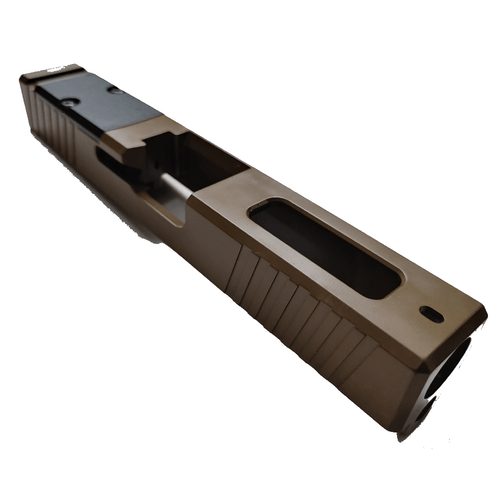
The Basics of a Window Cut
Window cut slides are one of the most common aftermarket slide styles for Glock pistols. They look aggressive, but the real question is whether those cutouts do anything functional. The answer is yes — but with trade-offs.
A window cut is a rectangular or angled port machined through the top of the slide. It exposes part of the barrel and removes material from the reciprocating mass. Most aftermarket window slides for Glock 19 and Glock 17 frames feature one or two top-side windows, sometimes paired with side serrations or lightening cuts.
Does a Window Cut Reduce Weight?
Yes. Removing steel from the slide reduces its overall mass. A standard Glock 19 OEM slide weighs roughly 12.5 ounces. A window cut slide typically comes in 0.5 to 1.5 ounces lighter depending on how much material is removed and whether additional lightening cuts are present.
That weight reduction has a mechanical effect. A lighter slide means the recoil spring can push it back into battery faster. In theory, this speeds up the cycling rate slightly. In practice, most shooters will not notice the difference at typical firing speeds. Where it can matter is in competition shooting, where split times between shots are measured in hundredths of a second.
Heat Dissipation: Real or Marketing?
Partially real. The window cut exposes the barrel to open air, which allows some additional heat to escape during sustained fire. A closed slide traps heat around the barrel and chamber. An open window lets convective cooling happen faster.
That said, you would need to be running hundreds of rounds in a short session to generate enough heat for the difference to matter. For a typical range day — 50 to 200 rounds at a casual pace — the cooling benefit is negligible. For high-volume training classes or competition stages, it provides a marginal advantage.
Does the Window Affect Reliability?
This is the most common concern, and it is worth addressing honestly. The window cut creates an opening where debris, sand, or carbon fouling could theoretically enter the slide. In clean range conditions, this is a non-issue. In dusty or dirty environments, there is a slightly elevated risk of foreign material reaching the firing pin channel or extractor.
Most shooters running aftermarket window slides in normal conditions report no reliability issues. If you are building a duty or defensive pistol that might see mud, sand, or extreme conditions, a closed-top slide is the more conservative choice. For range use, competition, or a dedicated home defense gun, window cuts are perfectly reliable.
Window Cut vs. Lightening Cuts vs. Porting
These three terms get mixed up often. Here is the difference:
- Window cut — a port machined through the top of the slide, exposing the barrel
- Lightening cuts — material removed from the sides or top of the slide without fully penetrating through. These reduce weight but do not expose the barrel.
- Barrel porting — holes drilled in the barrel itself to redirect gas upward and reduce muzzle rise. This is a barrel modification, not a slide modification.
Some slides combine all three. A windowed combat slide with a ported barrel will be lighter and have reduced muzzle flip compared to a standard slide and barrel combo.
What to Look for in a Window Cut Slide
Material and finish quality matter more than the window itself. Look for slides machined from 17-4 stainless steel or 416R stainless with a durable finish — black nitride (also called melonite or QPQ) or Cerakote. The assembled FDE window slide with ported barrel for Glock 19 is an example of a complete unit that comes ready to mount with barrel, sights, and internals already installed.
If you prefer to choose your own barrel and parts, a stripped DLC window cut slide for Glock 19 gives you that flexibility. Pair it with a barrel and slide parts kit to complete the assembly.
Who Should Run a Window Cut Slide?
If you want a lighter slide for faster cycling, a window cut makes sense. If you want the look — and that is a valid reason — go for it. If you are building a hard-use pistol for adverse conditions, stick with a closed slide. For most Glock owners shooting at the range or keeping a nightstand gun, a window cut slide is functional, reliable, and looks sharp on the frame. Browse the full selection of assembled slides for Glock to see what is in stock.
DISCLAIMER: GLOCK is a federally registered trademark of GLOCK, Inc. and is one of many trademarks owned by GLOCK, Inc. or GLOCK Ges.m.b.H. Neither 3CR Tactical nor this site are affiliated with, or endorsed by, GLOCK, Inc. or GLOCK Ges.m.b.H. The use of “GLOCK” on this page is merely to advertise the sale of aftermarket GLOCK pistol components. For genuine GLOCK, Inc. products, visit www.glock.com.
Shop Window-Cut Assembled Slides
Like the look of a window cut? Our Glock 43/43X Windowed RMSc slide is shop-assembled and ready to run. Browse all assembled Glock slides.