

Walk into any gun shop or scroll any AR-15 parts forum and you'll find strong opinions about free-float handguards. "Free-float or bust." "The accuracy difference is negligible." "You need a torque wrench." "It's just a barrel nut swap."
The noise around this topic tends to skip the most important question: do you actually need a free-float handguard for what you're doing with your rifle? This guide answers that first, then explains the mechanical differences so you can make an informed decision.
What's the Functional Difference?
A drop-in handguard (also called two-piece or carbine-length) attaches at the front to the delta ring assembly on the barrel nut and at the rear to the front of the lower receiver. On most standard AR-15s, the handguard halves snap into place in under a minute. No tools.
The key limitation: the handguard's front end contacts a cap that presses against the barrel. Pressure from accessories, a tight sling, or a bipod can transmit into the barrel itself, shifting point of impact between shots.
A free-float handguard attaches only at the barrel nut. Its front end does not touch the barrel at any point. Once installed, nothing you attach to the handguard — bipods, lights, lasers, vertical grips — contacts the barrel. Pressure can't affect your zero.
When It Actually Matters
Free-float makes a measurable difference in precision scenarios: shooting from a supported position with a bipod or bags, long-range work where each shot's repeatability counts, and competitive disciplines where the smallest variability reduction matters.
For the average range rifle or home-defense carbine, the accuracy gap between a quality drop-in and a free-float is small enough that ammunition selection, trigger pull, and shooter fundamentals will have more impact. If you're punching paper at 50-100 yards, running drills, or keeping a rifle staged for home defense, a quality drop-in handguard is not holding you back.
The Barrel Nut Difference
This is where many builders get surprised by free-float installation.
Drop-in handguards use the factory delta ring assembly that comes on most complete uppers. You don't touch the barrel nut. The handguard snaps in around the existing nut. No torque spec, no special tools required.
Free-float handguards require a different barrel nut — one their specific handguard attaches to. This means:
- Remove the delta ring, weld spring, and snap ring
- Unthread the factory barrel nut
- Apply Rocksett or anti-seize to the receiver threads
- Install the new barrel nut to spec (typically 30-80 ft-lbs, aligned to the gas tube hole)
- Attach the handguard body
You need an armorer's wrench. Mil-spec compatible barrel nuts accept a standard armorers tool. Some free-float systems use proprietary barrel nuts that require brand-specific installation tools.
Rail Standards: M-LOK vs KeyMod vs Picatinny
Picatinny (MIL-STD-1913) is the classic continuous-rail system. Universal compatibility — every piece of tactical hardware fits without adapters. Heavier than modern alternatives but nothing beats it for breadth of accessory compatibility.
M-LOK is the current standard in new production. It's lighter than Picatinny, stronger than KeyMod under lateral loads, and adopted by most major manufacturers. M-LOK accessories are now more widely available than KeyMod in new production.
KeyMod was the main alternative to Picatinny before M-LOK gained dominance. Testing showed M-LOK outperforms KeyMod in slippage resistance under stress. New handguard production has largely shifted to M-LOK.
Which One Should You Buy?
Get a drop-in if: You're not doing precision shooting from supported positions. You want a quick, tool-free upgrade to add M-LOK accessory slots or improve grip. You're building a range gun, home-defense rifle, or general-purpose carbine.
Get a free-float if: You're doing bench shooting, 3-gun competition, or any scenario where you're resting the rifle on a bipod and care about shot-to-shot consistency. You're adding a heavy bipod and don't want its torque to affect your zero.
In-Stock Options
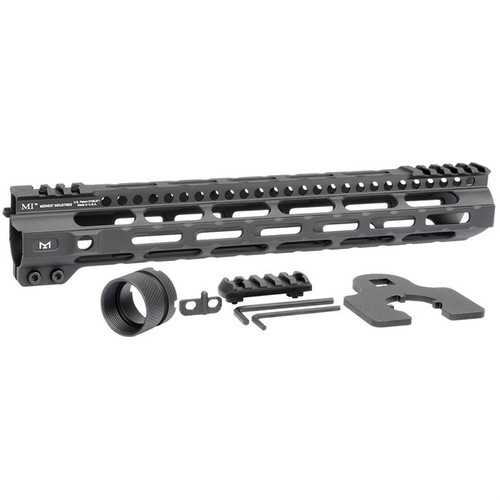
- Midwest Industries 12.625" Lightweight M-LOK Handguard — free-float, mil-spec barrel nut compatibility, 12.625" length fits 14.5" and 16" barrels. One of the best-value free-float options available.
- Presma M-LOK Free Float with Integrated Hand Stop — free-float with a built-in hand stop, saves a separate purchase if you run an AFG or thumb-index shooting technique
- B5 Systems M-LOK Carbine Two-Piece — drop-in replacement, B5 Systems quality, M-LOK slots with zero barrel nut work required
If you're on the fence, start with the B5 Systems drop-in — install in under a minute, no tools, see if you notice any difference. If you decide to free-float later, you haven't committed to a complex install before you're ready.